
50 Crucial Competencies: Which ones should your people have?
By Michaela Picones |
1.7 min read
Competence is a very broad term; it can include having the knowledge and skill to solve a quadratic equation or it can also mean having good interpersonal communication skills. Competence on a task or job means that you can think or behave in a matter that allows you to perform that job. The root of competence lies in the debate about general intelligence – IQ or g. The problem with IQ tests is that any human characteristic can be altered by experience. At Predictive Success, we know how complex and fantastically adaptable humans are. That is why g is what we measure with The PI Cognitive Assessment. When it comes to aligning your talent strategy to your business strategy, it will be important to identify the core competencies in your organization and reflect on how they’re a strategic advantage over the competition.
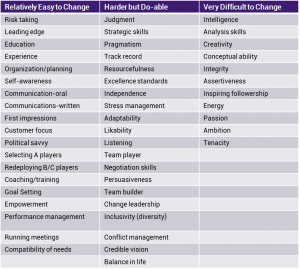
When you are an individual who is looking to find out exactly what competencies it takes to do your role, whether that be to be a good scientist, entrepreneur, teacher, or anything else, you would usually go out into the field, find and study these people, and try to figure out how the thoughts and actions of good and poor performers differ. The danger here is that you can wind up with very many, detailed lists of skills and knowledge elements. In his new book, The Science of Dream Teams, Mike Zani, CEO of The Predictive Index, outlines 50 crucial competencies. Zani states “for the relatively easy to change and the harder but do-able columns, coaching can help. The very difficult to change list is best addressed through proper hiring”. If you’re a leader who is defining your organization’s core competencies, it will be important to keep these competencies in mind.
To learn more about how our clients are adopting the data-driven approach when it comes to optimizing their talent, click here.
References:
https://www.businessnewsdaily.com/15792-business-core-competencies.html
https://www.businessnewsdaily.com/15792-business-core-competencies.html

Michaela Picones
Related Blogs

How Predictive Analytics in HR Improves Employee Retention
Predictive Analytics in HR: How Top Companies Reduce Turnover Before It Happens Employee turnover has always been one of the most expensive challenges organizations face. Replacing a high-performing employee isn't simply about filling an open

How to Build a People Strategy Roadmap for Growth: A Step-by-Step Guide for HR Leaders
Key Takeaways: Aligning people strategy with business objectives through talent optimization leads to faster growth and improved organizational performance. A six-step, science-backed framework, spanning executive alignment, role design, hiring, manager enablement, engagement diagnostics, and ongoing

People Strategy Operating Model Template: A Step-by-Step Guide for HR Leaders
Key Takeaways: A structured people strategy operating model, powered by behavioral analytics and proven frameworks, directly links HR actions to measurable business outcomes such as faster decision-making, reduced turnover, and improved employee engagement. Implementing science-backed