

Why AI Is Changing the Definition of Smart and What HR Should Do About It
By Adrienne Reilly |
5.6 min read
The New Definition of Smart And What It Means for Hiring, Leadership, and Talent Strategy
Why AI Is Forcing Us to Rethink What “Talent” Really Looks Like
Not long ago, being considered “smart” at work usually meant one thing: you were the person with the answers.
High GPA. Technical expertise. Strong problem-solving skills. The person who could figure things out faster than everyone else. The definition of smart in the AI age is changing faster than most organizations realize.
But according to Jensen Huang, CEO of NVIDIA, that definition is quickly becoming outdated.
In the age of AI, he argues, technical problem-solving is becoming a commodity. AI can code. AI can analyze data. AI can summarize reports. AI can even generate strategies.
So if AI can do the “smart” tasks we used to value most, what does a smart person look like now?
His answer has big implications for how organizations hire, develop leaders, and build teams.
And it connects directly to the work we do every day with Predictive Success and the The Predictive Index.
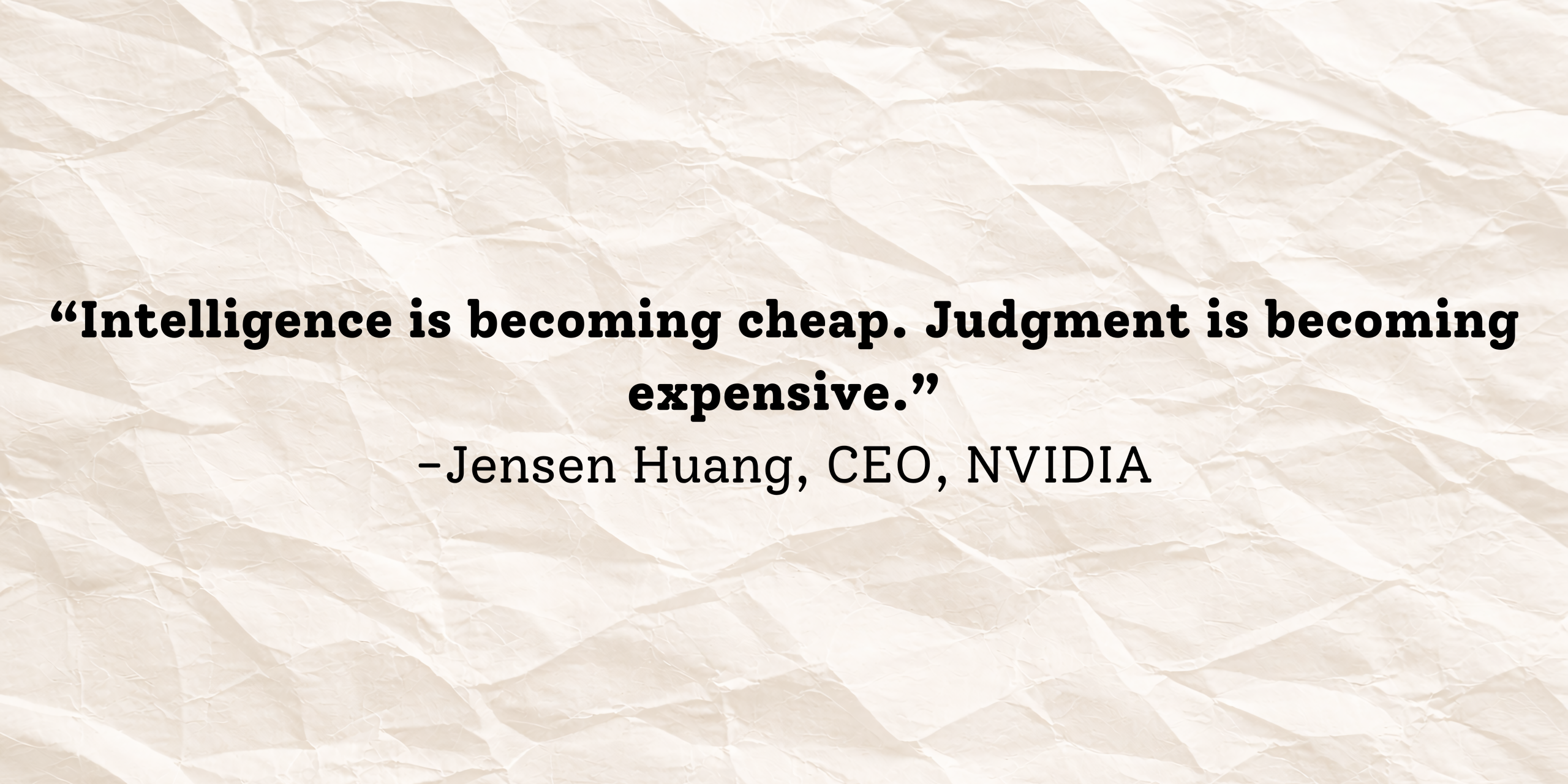
Intelligence Is Becoming Cheap. Judgment Is Becoming Expensive.
For years, companies hired for intelligence and experience.
Now, increasingly, companies need to hire for judgment.
Because AI can give you answers.
But AI cannot decide:
- Which problem is worth solving
- Which risk is worth taking
- Which person is the right fit for a role
- When to move fast and when to slow down
- How a decision will impact people, culture, and customers
Those are judgment calls. And judgment is human.
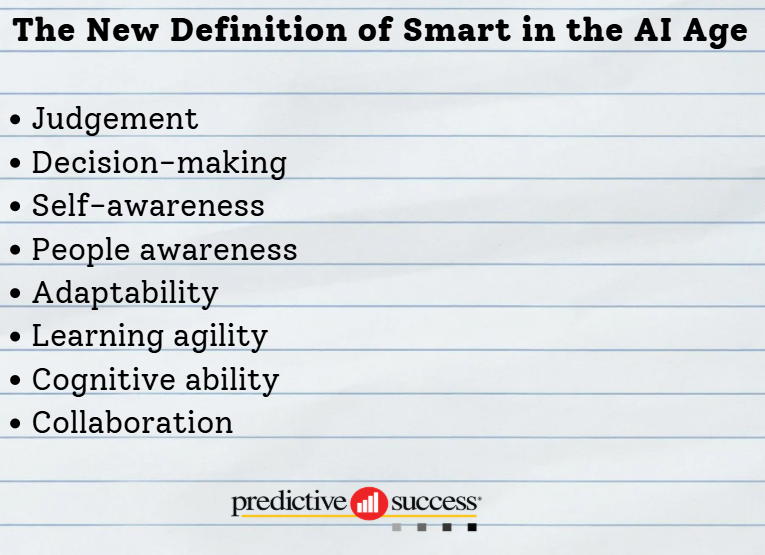
The new definition of “smart” is not the person who knows the most.
It’s the person who can:
- Make decisions with incomplete information
- Anticipate problems before they happen
- Read a room
- Ask better questions than everyone else
- Combine data with experience and intuition
- Adapt quickly when the situation changes
In other words, the smartest person in the AI age is the person who knows how to think, not just what to know.
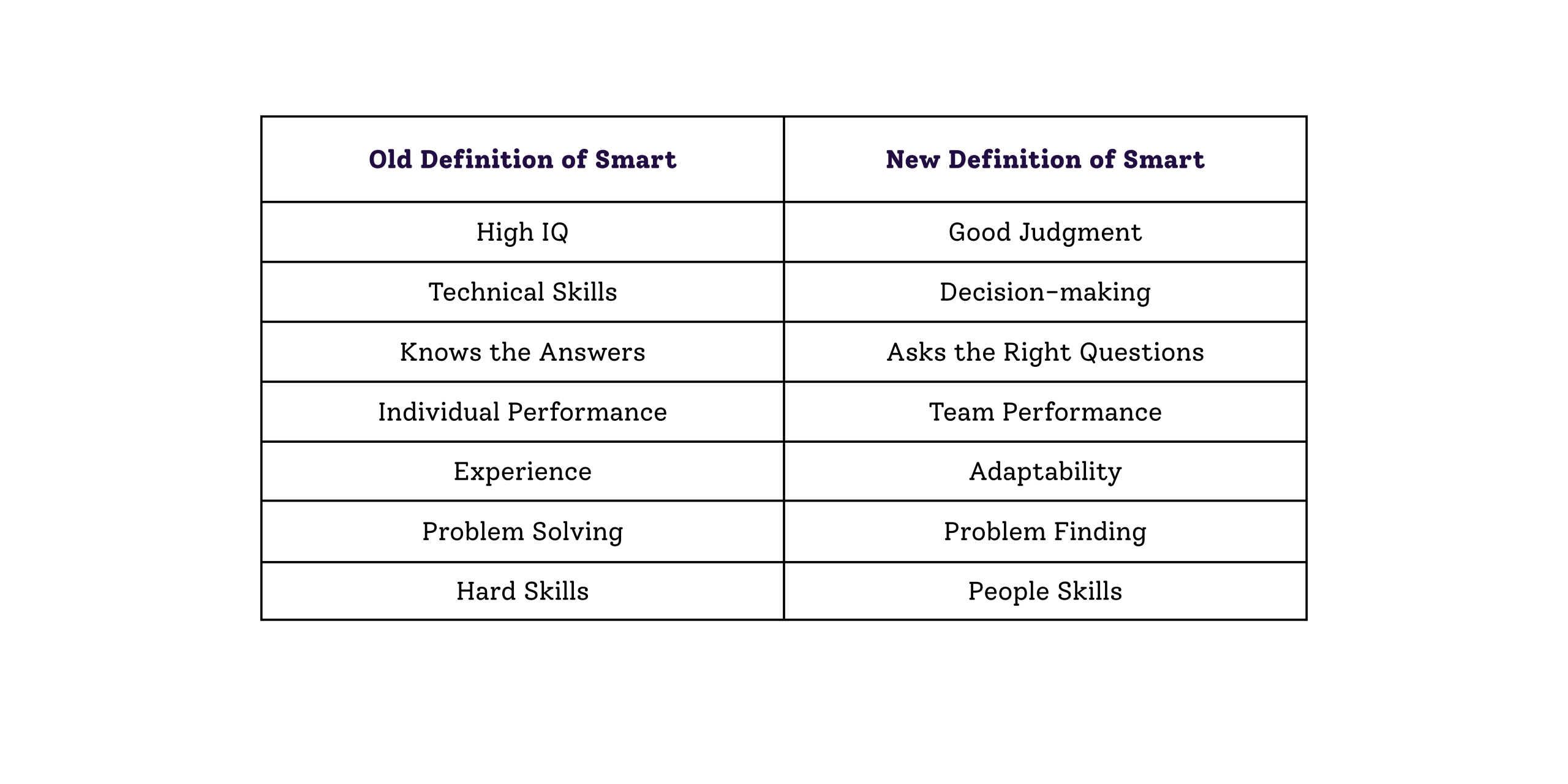
The Shift HR Leaders Need to Understand
This is where many organizations are at risk right now.
Most hiring processes still prioritize:
- Experience
- Education
- Technical skills
- Hard skills
- Past job titles
But those things tell you what someone has done, not how they think, decide, adapt, lead, or collaborate.
And in a world where jobs are changing faster than ever, hiring based only on experience is like hiring based on a snapshot of the past instead of a predictor of the future.
This is exactly why more organizations are shifting toward predicting workplace behavior, not just evaluating resumes.
This Is Where The Predictive Index Comes In
The The Predictive Index was built on a very simple but powerful idea:
Behavior drives performance.
And behavior is predictable.
Resumes tell you:
- Where someone worked
- What someone studied
- What someone says they can do
But behavioral data tells you:
- How someone makes decisions
- How someone handles pressure
- How someone communicates
- How someone leads
- How someone responds to change
- How someone takes risks
- How someone solves problems
- How someone works on a team
If the new definition of “smart” is judgment, adaptability, and people awareness — then the real question becomes:
How do you measure that?
You don’t measure it with a resume.
You don’t measure it with an interview alone.
You measure it by understanding behavioral drives and cognitive ability — which is exactly what The Predictive Index helps organizations do.
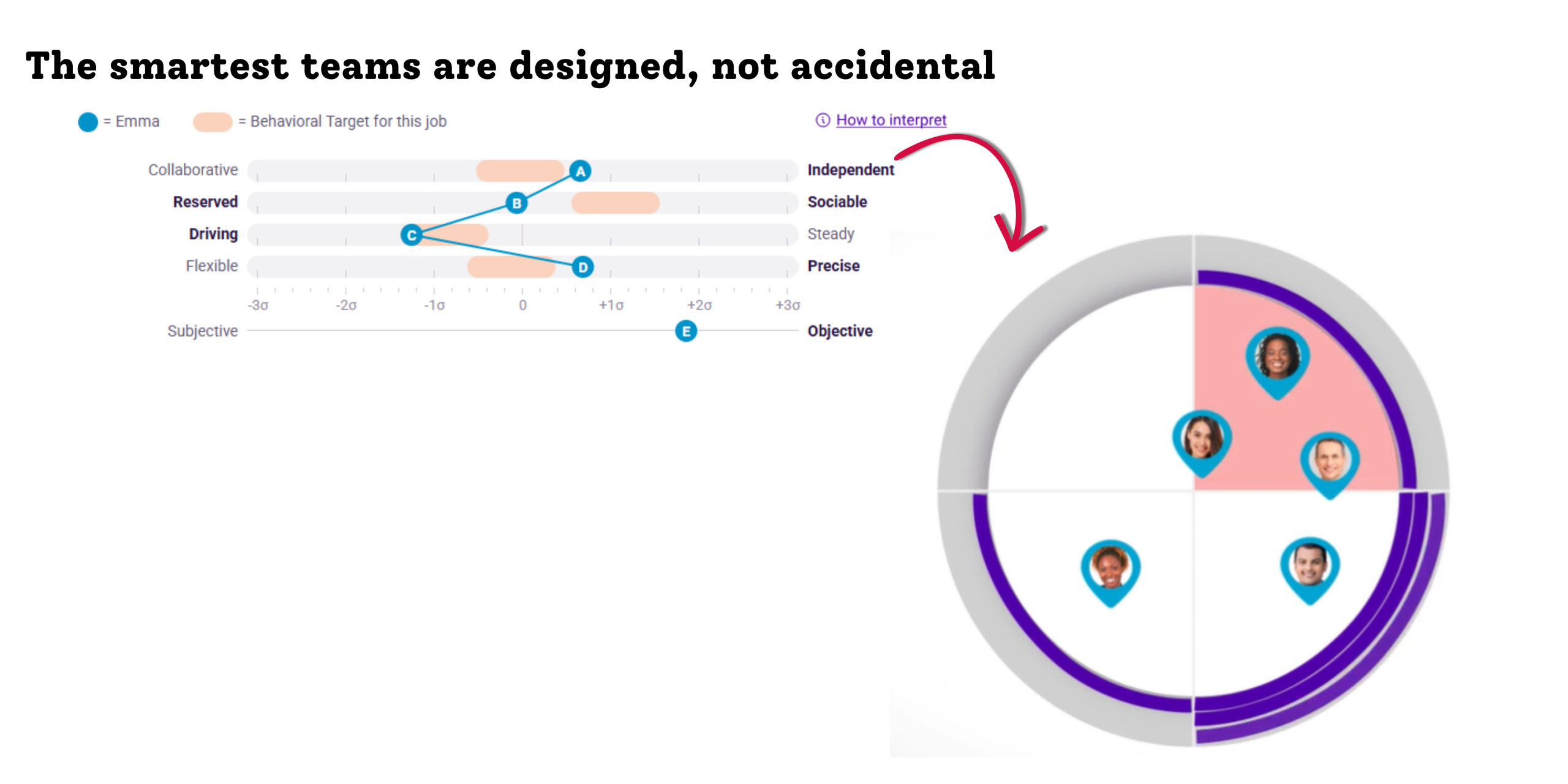
In the AI Age, Team Design > Individual Intelligence
The Smartest Teams Aren’t Made of the Smartest Individuals
Another shift happening right now is this:
The most successful organizations are not the ones with the highest-IQ individuals.
They are the ones with the best-designed teams.
Because in today’s world, success depends on:
- Collaboration
- Communication
- Innovation
- Speed
- Trust
- Decision-making under pressure
That requires different types of thinkers, not the same type of “smart” person over and over again.
Some people:
- Move fast
- Take risks
- Challenge ideas
- Push for change
Others:
- Think carefully
- Reduce risk
- Create structure
- Improve processes
- Maintain quality
You don’t need one of these.
You need both.
The problem is most companies accidentally hire the same profile repeatedly — especially if managers hire people like themselves.
The Predictive Index allows organizations to design teams on purpose, not by accident.
And in the AI age, team design may matter more than individual intelligence.
What This Means for Leadership
If the definition of smart has changed, then the definition of a good leader has changed too.
In the past, leaders were often the smartest or most experienced person in the room.
Today, the best leaders are the ones who:
- Ask the best questions
- Make decisions when there is no clear answer
- Understand how different people are wired
- Build balanced teams
- Create clarity in uncertainty
- Know when to trust data and when to trust people
- Can adapt their leadership style to different individuals
This is why self-awareness and people-awareness are becoming core leadership skills, not “soft skills.”
And again, this is where behavioral insights become incredibly powerful — because you cannot adapt your leadership style if you don’t understand:
- Your own natural style
- Your team’s natural styles
- Where friction might occur
- What motivates each person
- How each person prefers to communicate and make decisions
The Organizations That Will Win
The companies that will succeed in the next 10 years will not be the ones with the most data or the most AI.
They will be the ones that:
- Make better decisions
- Hire the right people
- Put people in the right roles
- Build balanced teams
- Develop better leaders
- Adapt faster than competitors
AI will be available to everyone.
Good judgment will not.
And good judgment comes from:
- Self-awareness
- People-awareness
- Cognitive ability
- Behavioral fit
- Experience
- Learning agility
In other words, it comes from understanding people — not just resumes.
Final Thought
For years, organizations asked:
“How smart is this person?”
Now the better question is:
“How does this person think, behave, decide, and work with others?”
Because in the AI age, being smart is no longer about having all the answers.
It’s about:
- Asking the right questions
- Making good decisions
- Working well with others
- Adapting quickly
- And seeing what’s coming before it arrives
And those are exactly the kinds of insights organizations can measure and develop using the The Predictive Index, as delivered by Predictive Success.
The definition of smart has changed.
The way we hire, develop, and lead people needs to change with it.
Related Blogs
Why AI Is Changing the Definition of Smart and What HR Should Do About It
The New Definition of Smart And What It Means for Hiring, Leadership, and Talent Strategy Why AI Is Forcing Us to Rethink What “Talent” Really Looks Like Not long ago, being considered “smart” at work
The New SWOT of a Leader: How HR Can Use Predictive Index to Grow Leaders and Business Performance
The New SWOT of a Leader™ How HR Can Leverage It to Grow Leaders and the Business For decades, organizations have relied on the classic SWOT framework — Strengths, Weaknesses, Opportunities, and Threats —

Is Gen Z Unemployable? A Talent Optimization Perspective
Is Gen Z “Unemployable”? What the Debate Really Means for Employers A recent opinion piece in The Wall Street Journal titled Is Gen Z Unemployable? sparked widespread discussion among business leaders and HR professionals. The