

Is Your Team Ready for AI? A Practical Assessment Guide
Is Your Team Ready for AI? A Practical Assessment Guide
Artificial intelligence is no longer an emerging trend reserved for innovation teams or tech-first organizations. It is quickly becoming embedded in how work gets done across every function, from hiring and onboarding to performance management and strategic planning. For HR leaders and executives, this shift introduces both opportunity and pressure.
The opportunity lies in unlocking better decision-making, increased efficiency, and more personalized employee experiences. The pressure comes from ensuring your organization can adopt AI in a way that is responsible, aligned, and sustainable.
Many organizations are already experimenting with AI tools. Fewer are seeing meaningful, scalable impact. The difference is not access to technology. It is readiness.
AI readiness is not about whether you have the right tools. It is about whether your leadership, roles, and culture are prepared to integrate those tools into how work actually happens.
This guide provides a comprehensive, practical framework to assess AI readiness across your organization. It is designed specifically for HR leaders and executives and grounded in the behavioral science and talent optimization approach of The Predictive Index as delivered by Predictive Success.
What Is AI Readiness in an HR Context?
AI readiness refers to your organization’s ability to successfully adopt, integrate, and scale artificial intelligence while maintaining alignment between strategy, people, and culture.
For HR leaders, AI readiness extends beyond systems and into the core of workforce strategy. It includes:
- Leadership alignment on why AI matters and where it should be applied
- Role clarity in an environment where responsibilities are evolving
- Workforce capability, including both skillsets and behavioral adaptability
- Cultural openness to experimentation, change, and continuous learning
AI readiness is dynamic. It evolves as your organization grows, as technology advances, and as employee expectations shift.
A helpful way to think about AI readiness is this: it is your organization’s capacity to turn AI potential into consistent performance.
Check out this blog post on Why AI is Changing the Definition of Smart and What HR Should Do About It from Predictive Success
The AI Readiness Framework for HR Leaders
To make AI readiness practical and measurable, it can be broken down into three interconnected pillars:
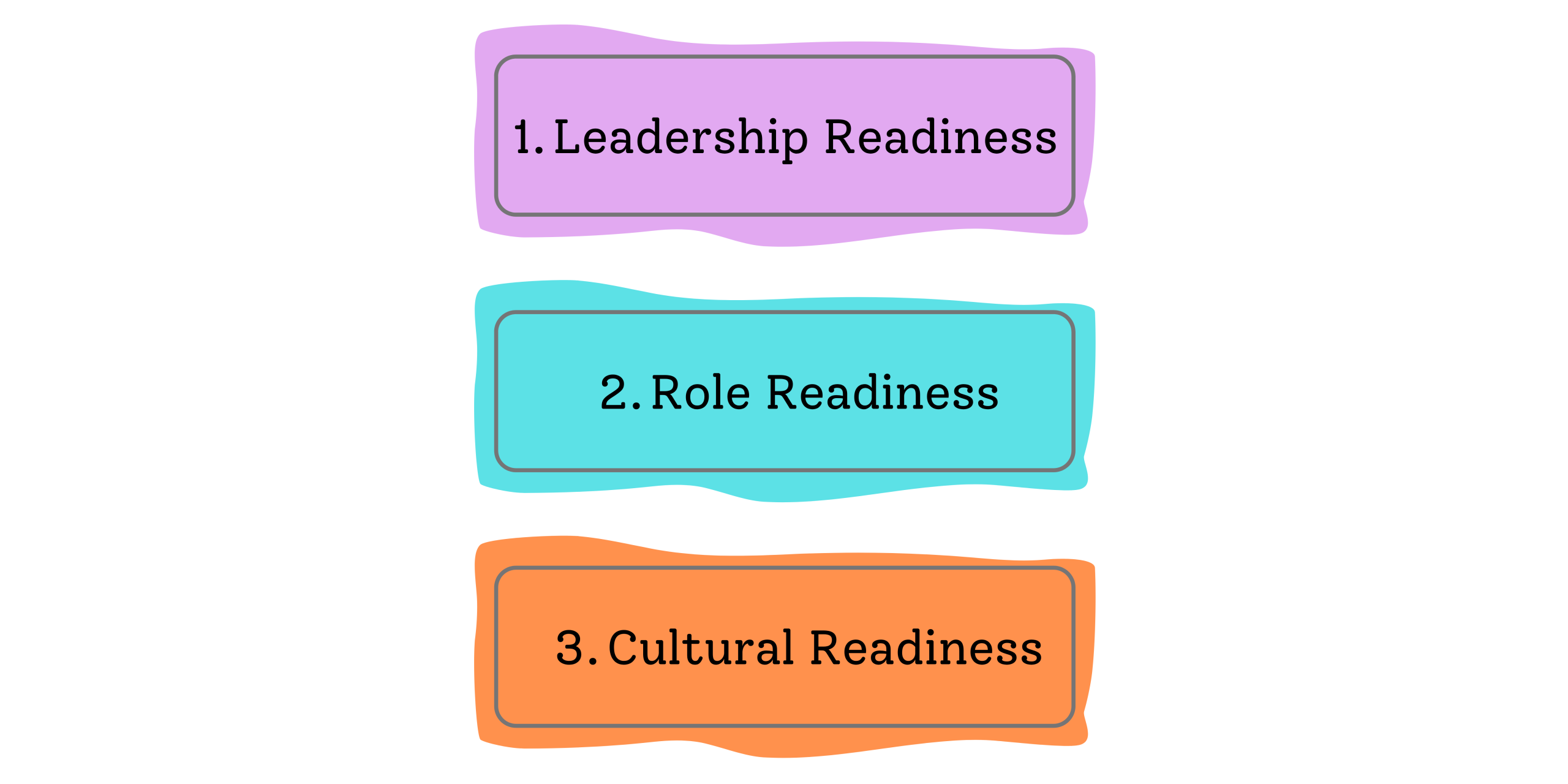
Each pillar addresses a different dimension of the organization, but they are deeply interdependent.
If leadership is unclear, roles become misaligned. If roles are unclear, employees become disengaged or resistant. If culture does not support change, even well-designed strategies fail.
The most effective AI transformations occur when all three pillars are addressed together.
Leadership Readiness: Setting Direction and Driving Alignment
Leadership readiness is the foundation of AI success. Without alignment at the top, AI initiatives tend to become fragmented, inconsistent, and difficult to scale.
Importantly, leadership readiness is not about technical expertise. Leaders do not need to build AI models. They need to understand where AI creates value, how it impacts their workforce, and how to guide the organization through change.
What Leadership Readiness Looks Like
Organizations with strong leadership readiness typically demonstrate:
- A clearly articulated AI strategy tied to business objectives
- Alignment across the executive team on priorities and investment areas
- Defined metrics for success, such as productivity gains or improved decision-making
- Awareness of the human impact of AI, including role changes and skill gaps
Leaders in these organizations communicate consistently, make informed decisions, and create a sense of direction that employees can follow.
Where Leadership Often Falls Short
Despite good intentions, many leadership teams struggle with AI readiness in predictable ways.
Some leaders become overly enthusiastic, pushing AI into multiple areas without clear prioritization. This creates confusion and dilutes impact.
Others remain skeptical, delaying adoption due to perceived risks or lack of understanding. This can leave the organization behind competitors.
A third group delegates AI entirely to IT or innovation teams, treating it as a technical initiative rather than a strategic one. This disconnect often leads to low adoption among employees.
Using The Predictive Index to Strengthen Leadership Alignment
The Predictive Index provides valuable insight into how leadership teams make decisions, communicate, and respond to change.
For example:
- Leaders with high dominance and urgency may push for rapid AI adoption but overlook stakeholder alignment
- Leaders with high caution and formality may carefully evaluate risks but delay action
By understanding these behavioral dynamics, organizations can create more balanced and effective leadership approaches.
Through Predictive Success, leadership teams can align on strategy, clarify roles in decision-making, and build a unified approach to AI adoption.
Leadership Readiness Checklist
- Clear and communicated AI vision
- Alignment across executive stakeholders
- Defined success metrics and KPIs
- Understanding of workforce implications
- Ongoing leadership development and support
Role Readiness: Redefining Work in an AI-Enabled Organization
Once leadership is aligned, the next challenge is translating strategy into day-to-day work. This is where role readiness becomes critical.
AI does not simply automate tasks. It changes how work is structured, how decisions are made, and what skills are required.
For HR leaders, role readiness is about ensuring that employees understand their responsibilities, feel confident in their ability to adapt, and are aligned with evolving business needs.
What Role Readiness Looks Like
Organizations with strong role readiness demonstrate:
- Clearly defined roles that reflect AI integration
- Employees who understand how AI impacts their responsibilities
- Alignment between individual strengths and role requirements
- Structured development plans to support skill growth
These organizations treat role design as an ongoing process, not a one-time exercise.
The Impact of Role Ambiguity
When roles are not clearly defined in the context of AI, organizations experience:
- Increased employee anxiety and resistance
- Duplication of effort or underutilization of AI tools
- Difficulty measuring performance and outcomes
This ambiguity slows adoption and reduces the effectiveness of AI initiatives.
Using The Predictive Index to Align Roles and Talent
The Predictive Index enables HR leaders to take a data-driven approach to role design and talent alignment.
Key capabilities include:
Job Targeting
Define the behavioral and cognitive requirements of roles in an AI-enabled environment.
Talent Mapping
Assess how well individuals align with role requirements and identify potential gaps.
Workforce Planning
Make informed decisions about hiring, reskilling, and restructuring.
Delivered through Predictive Success, this approach ensures that roles evolve in a way that supports both organizational performance and employee success.
Role Readiness Checklist
- Updated job descriptions reflecting AI integration
- Clear communication about role changes
- Alignment between talent and role demands
- Investment in training and development
- Manager capability to support evolving roles
Cultural Readiness: Creating an Environment That Supports AI Adoption
Culture is often the deciding factor in whether AI initiatives succeed or fail.
Even with strong leadership and well-defined roles, a culture that resists change will limit progress. Conversely, a culture that encourages curiosity and learning can accelerate adoption.
What Cultural Readiness Looks Like
Organizations with high cultural readiness demonstrate:
- Openness to experimentation and new ideas
- Trust in leadership decisions
- Collaboration across teams
- A strong focus on learning and development
Employees in these environments are more likely to engage with AI tools, share insights, and contribute to continuous improvement.
Common Cultural Barriers
Several cultural challenges frequently emerge during AI adoption:
- Fear of job displacement
- Lack of psychological safety
- Resistance to new tools and processes
- Siloed teams and limited knowledge sharing
Addressing these barriers requires intentional effort and consistent leadership behavior.
Using The Predictive Index to Shape Culture
With The Predictive Index, organizations can measure and understand behavioral patterns across their workforce.
This enables HR leaders to:
- Identify cultural strengths and gaps
- Understand how teams respond to change
- Design targeted interventions to support adoption
Through consulting and workshops from Predictive Success, organizations can build cultures that are resilient, adaptable, and ready for continuous transformation.
Cultural Readiness Checklist
- Transparent communication about AI initiatives
- Leadership modeling adaptability and curiosity
- Safe environment for experimentation
- Recognition of learning and innovation
- Strong collaboration across teams
AI Readiness Scorecard for HR Leaders
To bring structure to your assessment, use a simple scoring model across the three pillars.
Leadership (1–5)
- Strategy clarity
- Alignment
- Decision-making capability
Roles (1–5)
- Role clarity
- Talent alignment
- Skill readiness
Culture (1–5)
- Change readiness
- Trust and communication
- Learning mindset
Scoring Interpretation
- 12–15: Ready to scale AI initiatives
- 8–11: Ready for targeted pilot programs
- Below 8: Focus on foundational alignment before expanding AI efforts
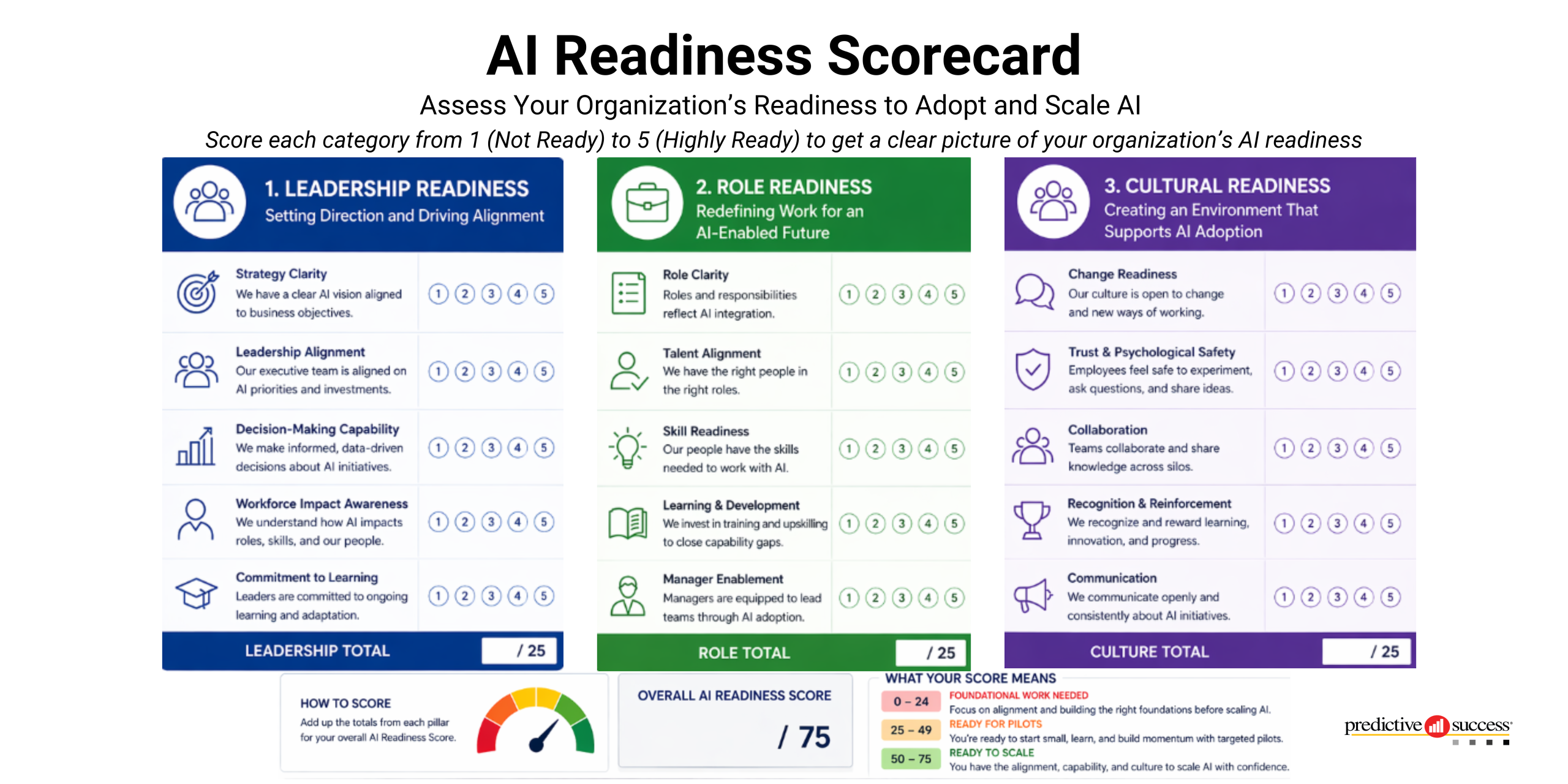
This scorecard helps prioritize where to focus resources and attention.
Real-World Example: Moving from AI Interest to AI Impact
A mid-sized professional services organization recognized the potential of AI but struggled to move beyond initial experimentation.
Challenges
- Leadership lacked alignment on where to focus AI efforts
- Employees were unclear on how AI would impact their roles
- The culture was cautious and hesitant to adopt new tools
Approach
Working with Predictive Success, the organization:
- Aligned leadership using behavioral insights
- Redefined roles using job targeting and talent mapping
- Delivered workshops to build a culture of experimentation
Results
- Increased adoption of AI tools across teams
- Improved clarity in roles and expectations
- Higher employee engagement and confidence
This example highlights that successful AI adoption is driven by alignment, not just technology.
Embedding AI into Everyday Work with PI Assistant
A significant advancement within The Predictive Index is the PI Assistant.
This AI-powered capability integrates directly into talent decision-making, allowing leaders to:
- Access insights quickly and easily
- Make more informed hiring and management decisions
- Align teams with greater precision
Rather than treating AI as a separate initiative, the PI Assistant embeds it into everyday workflows, making AI adoption more natural and sustainable.
Common Mistakes HR Leaders Should Avoid
Starting with tools instead of strategy
Without clear objectives, tools create noise rather than value.
Ignoring behavioral dynamics
Not all employees respond to change in the same way. Understanding these differences is critical.
Underinvesting in change management
AI adoption requires communication, training, and ongoing support.
Treating AI as a one-time project
AI readiness is continuous. It evolves alongside your organization.
AI Readiness Checklist for Organizations
Leadership
- Clear AI strategy aligned to business goals
- Executive alignment
- Defined success metrics
Roles
- Updated job definitions
- Alignment between talent and roles
- Training and development plans
Culture
- Open communication
- Support for experimentation
- Trust in leadership
FAQs: AI Readiness for HR Leaders
What is AI readiness in HR?
AI readiness in HR refers to an organization’s ability to integrate AI into talent strategies while aligning leadership, roles, and culture.
How can HR leaders assess AI readiness?
HR leaders can assess AI readiness using structured frameworks that evaluate leadership alignment, role clarity, and cultural adaptability, supported by data from The Predictive Index.
What are the biggest barriers to AI adoption?
The most common barriers include lack of leadership alignment, unclear roles, and resistance to change.
How does The Predictive Index support AI transformation?
The Predictive Index provides insights into behavior and cognition, enabling organizations to align people strategy with AI initiatives.
Will AI replace jobs?
AI is more likely to augment roles than replace them entirely. Organizations that proactively redesign roles and invest in development will benefit the most.
Internal Links to Explore
To strengthen your AI readiness strategy, check out these offerings from Predictive Success:
- Talent Optimization Services
- Leadership Development Programs
- Team Discovery Workshops
- Workforce Planning Solutions
Final Thoughts: AI Readiness Is a Leadership and Talent Imperative
AI is not just a technological advancement. It is a shift in how organizations operate, make decisions, and develop talent.
The organizations that succeed will not be those that adopt AI the fastest, but those that adopt it the most effectively.
That effectiveness comes from alignment. Alignment in leadership. Alignment in roles. Alignment in culture.
By leveraging The Predictive Index through Predictive Success, HR leaders can take a structured, data-driven approach to AI readiness.
The question is no longer whether AI will impact your organization.
The question is whether your organization is ready to grow with it.

Adrienne Reilly
Adrienne Reilly is a Client Success Marketing Associate at Predictive Success Corporation, where she supports organizations in implementing The Predictive Index and enhancing their people strategy. She contributes to client onboarding, marketing initiatives, workshop facilitation, and event execution, helping deliver impactful client experiences.
Adrienne holds an Honours Bachelor of Science in Kinesiology from Ontario Tech University. With a background in healthcare and over 500 hours of clinical experience, she brings a people-first approach, strong communication skills, and a passion for building high-performing teams.
Related Blogs
Why Most Personality Tests Fail Business Leaders (And What Actually Works)
Why Most Personality Tests Fail Business Leaders And The One That Actually Works Most business leaders have taken a personality test at some point in their career. Maybe it happened during a leadership retreat. Maybe
60 High-Impact Performance Review Phrases (Strengths & Weaknesses)
Conducting effective performance reviews is one of the most important responsibilities of any manager or business owner. Done right, employee evaluations don’t just measure past performance, they review strengths and weaknesses, drive engagement, improve productivity,
Is Your Team Ready for AI? A Practical Assessment Guide
Is Your Team Ready for AI? A Practical Assessment Guide Artificial intelligence is no longer an emerging trend reserved for innovation teams or tech-first organizations. It is quickly becoming embedded in how work gets done